- Dormathon 2026
- 10–11 Oct 2026
- Track 1 · Predict Early, Decide Better
Scam Guardian
A pause before the money moves: a banking demo that tells a confused user from a coached one.
- TypeScript
- Expo
- React Native
- Tailwind CSS
- XGBoost
- Logistic regression
01The problem
In a coached scam, a caller posing as the police or the bank talks the victim through the transfer, live. Every security check passes: it is the right person, on their own phone, entering the correct PIN.
The hard part is that a slow user isn't a suspicious one. Older users hesitate and make mistakes naturally, so the app has to tell a confused person from a coerced one before they press Confirm.
02What Scam Guardian does
It is a mock banking app for Android and web that reads one transfer three ways and answers each one differently. No real money moves.
After the pause the choice is still theirs. Guardian adds time and support; it never blocks someone's own money.
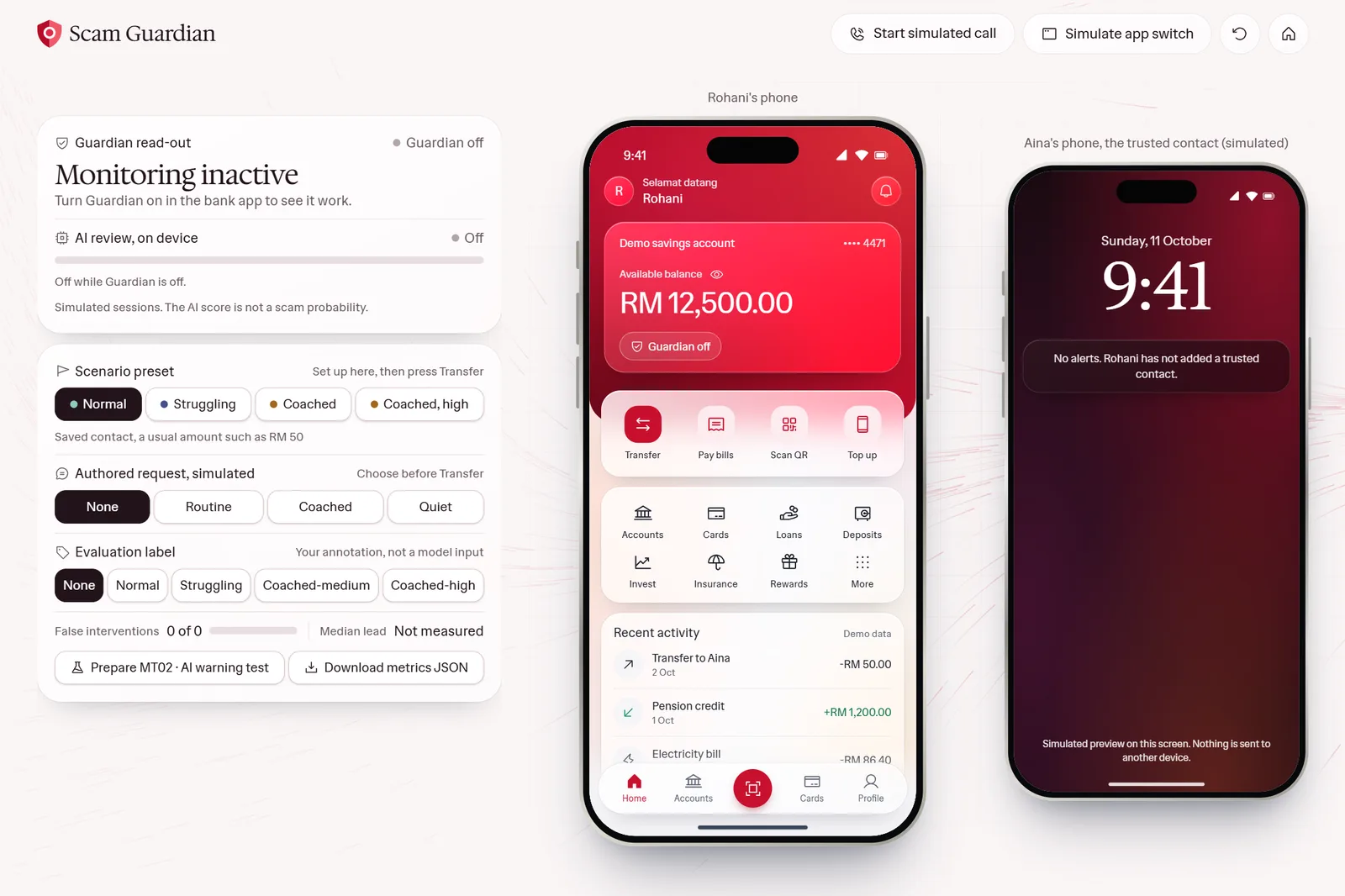
- ▸Normal: saved recipient, usual amount. No interruption.
- ▸Struggling: three back steps or two help taps turn on Simple mode, one instruction at a time with larger controls.
- ▸Coached: on a call and paying someone new. A 15-second pause asks whether someone is directing the transfer.
- ▸Coached, high: add a pasted account number or more than 3x the usual amount, and the trusted contact is asked to call.
03Rules and a model, both on the device
Two layers decide. A rule layer is deterministic and easy to explain. Beside it, two small frozen models score the transfer every 5 seconds: XGBoost on behaviour alone, and logistic regression once a payment request is present. Either layer can add the pause, and the read-out shows which one raised it.
Privacy shaped the inputs. The app records content-free events such as the length of an edit, typed versus pasted, back steps and help taps. No digits, names, amounts or call audio are collected, and no server is called.
- 01Collect content-free events during an opted-in transfer
- 02Summarise them into behaviour features every 5 seconds
- 03Score on the device with the rules and the frozen model
- 04First score over the threshold latches a review
- 05Pause for 15 seconds, then the person chooses
04What is real and what is simulated
A scam demo is easy to oversell, so the app labels what is simulated.
- ▸Simulated: the money, the account, the phone call, the app switch and the family alert. Nothing is read from the device's call state, and nothing is sent to another phone.
- ▸Working as shown: consent, the separate trusted-contact consent, the account-number field, Simple mode, the 15-second pause and on-device scoring.
- ▸The model was trained on simulated sessions only. Its score is not a scam probability.
05Results we kept visible
On the original simulated test set the model caught 647 of 720 coached sessions (89.9%) and raised a review on 2 of 720 legitimate ones. Then we wrote a harder 32-session challenge, and it caught 6 of 16.
- ▸A hand-set baseline using only the request cues caught 8 of 16, so the model is not shown to beat simple cues.
- ▸All 60 quiet scams in the original test, the ones with no telling wording, were missed.
- ▸Six of the ten challenge misses had inputs identical to a legitimate session. No model could tell those apart from what it was given.
- ▸Whether a warning changes what a person does has not been measured.
06What I learned
- ▸Scope: the whole product is one moment, the seconds before Confirm. SyncField taught me to lock a narrow problem first.
- ▸Baselines: 89.9% looked good until a simple cue matcher beat the model on new cases.
- ▸Honesty: a demo that says what it does not do is easier to defend than one that claims everything.
- ▸Design: help comes before suspicion. A struggling user gets Simple mode, not a fraud warning.
07Team
Three Peas in a Pod.
- ▸Tan Yit Shen
- ▸Yap Li Yang
- ▸Wee Lik Hui